Let's Work Together
Ready to
Move Forward?
Whether you're looking for a logistics partner, a government-ready contractor, or a team that simply gets things done — we'd love to hear from you.

info@isaacslogistics.com
.avif)
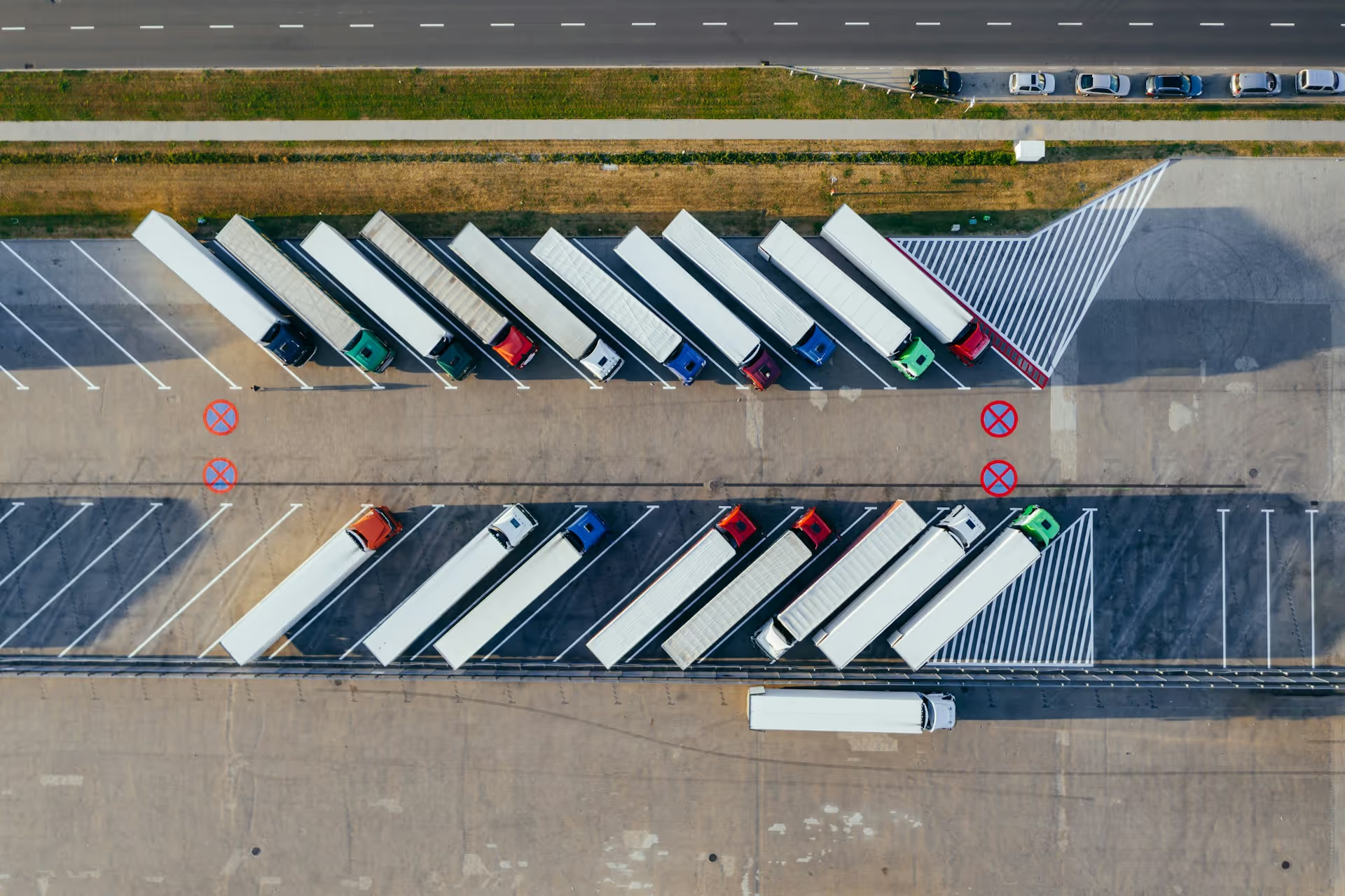
Why shipping failures happen, what they really cost a business, and how a problem-solving logistics partner prevents disruptions and resolves them fast when they do occur.
Every business that ships freight will eventually face a moment when something goes wrong. A truck breaks down. A storm closes a major corridor. A carrier drops the ball on a critical delivery. These are not rare, worst-case scenarios. They are routine realities of operating a supply chain in the real world.
What separates businesses that absorb these moments and keep moving from those that spiral into costly delays and damaged relationships is rarely luck. It is the quality of the logistics partner standing between the disruption and the resolution. Problem-solving logistics is not a marketing phrase. It is a measurable operational capability, and for businesses that depend on freight moving reliably, it may be the most important thing a logistics company can offer.
Trucks break down, equipment malfunctions, and capacity gaps open up without warning. A carrier who cannot fulfill a commitment at the last minute creates an immediate crisis for any business depending on that freight arriving on time.
In the Southeastern U.S., weather is a consistent freight challenge. Hurricanes, flooding, ice storms, and extreme heat can close roads, delay port operations, and disrupt regional distribution networks with very little advance notice.
Freight demand fluctuates, and carrier capacity does not always move with it. During peak seasons or periods of high regional demand, finding available trucks on short notice can be difficult and expensive.
Many shipping failures are not operational at their root. They are communication failures. Incorrect pickup times, missing documentation, unclear delivery instructions, and lack of status updates all create confusion that compounds into real delays.
Freight moving through regulated environments, including government contracts and cross-border shipments, is especially vulnerable to documentation errors. A missing form or an incorrect classification can stop a shipment cold.
A logistics provider that calls to inform you that your freight is delayed has fulfilled a basic communication obligation. A problem-solving logistics partner calls with the delay and the alternative already in motion. That distinction matters enormously when time is the most valuable thing at stake.
Problem-solving logistics is not only about what happens after something goes wrong. It is about anticipating where things are likely to go wrong and building systems to prevent or minimize the impact before the disruption ever occurs. That requires experience, regional knowledge, and a genuine investment in understanding each client's freight operation.
The defining characteristic of a true problem-solving logistics partner is ownership. When freight is delayed, damaged, or misrouted, the question is not whose fault it is. The question is what we are doing about it right now. Companies that operate with that mindset build trust quickly and hold it through difficult situations.
The immediate costs of a shipping failure are straightforward but significant:
When freight does not arrive on time, operations downstream feel it immediately. Production lines stop waiting on parts. Construction sites sit idle waiting on materials. Fulfillment centers fall behind on orders. Each hour of delay multiplies the impact across every part of the operation that depended on that shipment.
Late deliveries and supply chain failures are visible to customers in ways that internal operational problems are not. A missed commitment damages trust, and in competitive markets, trust is difficult and expensive to rebuild once it is lost.
For businesses that depend on repeat contracts, government relationships, or long-term client accounts, a pattern of shipping failures can have consequences that last far longer than any single incident. Reputation in logistics is built slowly and lost quickly.
Experienced logistics partners do not just pick the most obvious route for a shipment. They analyze freight lanes for known congestion patterns, facility bottlenecks, seasonal disruption risks, and compliance requirements. That upfront intelligence reduces the likelihood of delays and creates a cleaner path from origin to destination.
Proactive route planning includes:
A logistics partner with a single carrier option for every lane is one breakdown away from a problem it cannot solve. Partners who maintain deep, diverse carrier networks have options when primary carriers are unavailable, giving them the flexibility to keep freight moving regardless of individual carrier failures.
Staying ahead of problems requires knowing what is happening with freight in real time. Reliable logistics partners maintain active communication with carriers throughout a shipment, not just at pickup and delivery. When a potential delay is identified early, there is still time to act on it. When it is identified at the delivery window, there is not.
For businesses shipping regulated goods or working with government clients, documentation errors are a preventable cause of delays. A logistics partner who reviews documentation before freight moves and understands the compliance requirements for specific freight types eliminates a common and costly failure point before it has a chance to create a problem.
When a primary route or carrier fails, the clock starts immediately. The most effective logistics partners have backup carrier relationships and alternative routing options ready to activate without delay. The goal is to minimize the gap between the moment a problem is identified and the moment freight is moving again.
Effective rapid response includes:
Not every logistics problem has a straightforward solution. Sometimes the right answer requires thinking beyond the standard playbook. This might mean consolidating loads across multiple carriers, using alternative freight modes for part of a journey, or coordinating temporary storage while a primary solution is arranged. The willingness and ability to find creative solutions is what separates a true logistics partner from a transactional carrier relationship.
When a problem is being resolved, clients need clear and timely information. They do not need a stream of unfiltered updates that creates more confusion than clarity. The right communication approach during a disruption is:
Shipping will go wrong. That is not pessimism, it is the reality of moving freight through a complex, unpredictable world. The businesses that handle those moments best are not the ones with the most luck. They are the ones with the right partner.
At Isaacs Logistics, problem-solving is not a feature we offer. It is the foundation of how we operate. We specialize in middle mile transportation, freight delivery, supply chain coordination, and project-based logistics throughout the Southeastern U.S., and we bring the regional expertise, carrier relationships, and ownership mindset to handle what comes up, whatever that happens to be.
If you are tired of logistics partners who report problems instead of solving them, we would like to have a conversation.
Call us: (662) 722-2233 Email us: Info@isaaclogistics.com Visit us: 107 Mercer Dr., Simpsonville, SC 29681
Whether you're looking for a logistics partner, a government-ready contractor, or a team that simply gets things done — we'd love to hear from you.