Let's Work Together
Ready to
Move Forward?
Whether you're looking for a logistics partner, a government-ready contractor, or a team that simply gets things done — we'd love to hear from you.

info@isaacslogistics.com
.avif)

Why the Southeastern U.S. is a supply chain powerhouse and how regional middle mile trucking outperforms national carriers on speed, flexibility, and cost across key industries.
The Southeastern United States is one of the most commercially active regions in the country, and it is not slowing down. From the ports of Savannah and Charleston to the manufacturing corridors of South Carolina and Tennessee, goods are moving in every direction, every day. Behind all of that movement is a network of regional trucking companies quietly doing the work that keeps store shelves stocked, construction projects on schedule, and businesses running without interruption.
Southeastern trucking has evolved far beyond simply hauling freight from one place to another. Today, it is a sophisticated, relationship-driven industry built on speed, reliability, and the kind of regional knowledge that national carriers simply cannot replicate. Understanding how it works, and why it matters, is the first step toward building a supply chain that actually performs.
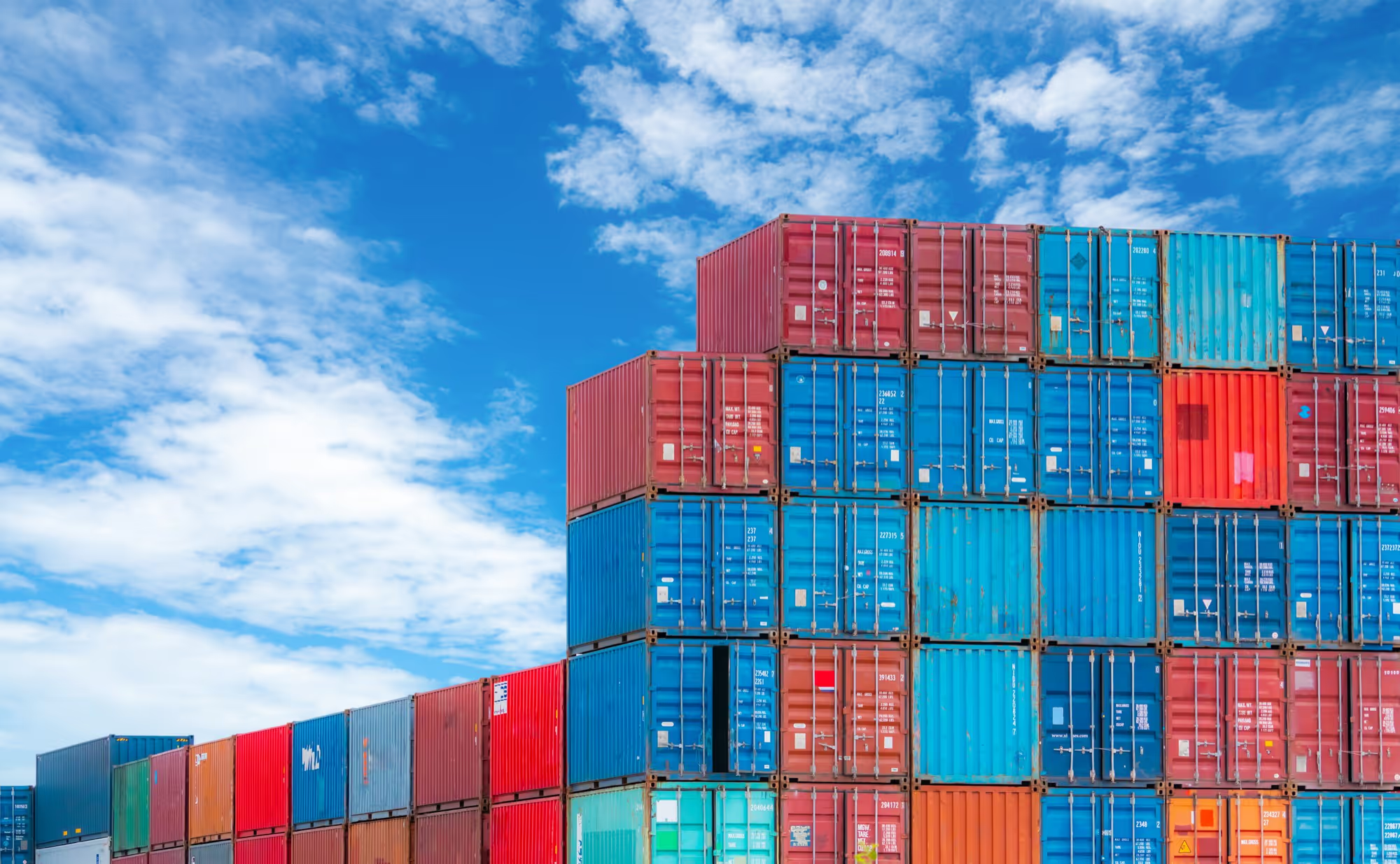
The Southeastern U.S. sits at the intersection of major interstate highways including I-85, I-95, I-40, and I-20, creating a dense network of freight corridors that connect the Atlantic Coast to the Gulf, and the Mid-Atlantic to the Deep South. Ports like Savannah, Charleston, and Jacksonville rank among the busiest container ports in the country, feeding enormous volumes of international freight directly into the regional supply chain.
Key geographic advantages include:
The Southeast is also one of the fastest-growing regions in the country by population. States like South Carolina, Georgia, North Carolina, and Tennessee have seen significant residential and commercial growth over the past decade, driving increased demand for freight transportation at every level of the supply chain. More people means more consumption, more construction, more healthcare, and more retail activity, all of which require reliable, regional trucking services to function.
Middle mile transportation is the bridge between large-scale freight movements and final delivery. It keeps inventory flowing between facilities so that last-mile carriers always have product available to deliver. Without a well-managed middle mile, distribution centers run short, delivery windows get missed, and the downstream effects ripple through the entire supply chain.
In the Southeastern U.S., middle mile logistics is especially critical because of the sheer number of distribution facilities, manufacturing plants, and regional hubs concentrated in states like South Carolina, Georgia, and North Carolina. Keeping freight moving between these points efficiently requires carriers who understand regional routes, facility schedules, and freight volumes at a granular level.
Middle mile transportation rarely gets the attention it deserves because it happens behind the scenes. Businesses tend to focus on inbound freight costs and last-mile delivery performance, leaving the middle leg underoptimized and undermanaged. This is where a regional logistics partner with specific middle mile expertise adds real, measurable value, reducing transit times, lowering costs, and removing the bottlenecks that slow the rest of the supply chain down.
Regional carriers know the roads, the traffic patterns, the weigh stations, and the shortcuts that national dispatchers working from a map cannot account for. That local knowledge translates directly into faster, more predictable transit times.
Benefits of regional route expertise include:
Regional trucking companies are built on relationships, with shippers, receivers, and local carrier networks. That relationship foundation creates flexibility that larger carriers simply do not offer.
For freight moving within the Southeast, regional carriers typically offer more competitive rates on shorter lanes because those lanes are their core business. Businesses are not paying for the overhead and infrastructure of a national network they are not using.
The growth of e-commerce has fundamentally changed freight patterns across the Southeast. Distribution centers for major retailers and online platforms are concentrated throughout the region, generating constant demand for middle mile transportation to move inventory between fulfillment locations and delivery hubs.
South Carolina, Tennessee, Alabama, and Georgia are home to a significant and growing manufacturing base, including automotive, aerospace, and industrial production. These facilities depend on just-in-time parts delivery and outbound freight coordination, making reliable regional trucking a non-negotiable part of their operations.
Healthcare freight is time-sensitive and unforgiving. Hospitals, medical distributors, and pharmaceutical companies operating in the Southeast rely on regional carriers to move supplies with precision and care. Delays in this sector have real consequences, which means the bar for reliability is exceptionally high.
The Southeast is in the middle of a long-running construction boom driven by population growth, commercial development, and infrastructure investment. Construction sites depend on scheduled, on-time delivery of materials and equipment. A missed delivery does not just cause inconvenience, it stops work and costs money.
Government agencies and federal contractors operating throughout the Southeast have specific logistics needs that require carriers experienced in compliance, documentation, and strict delivery timelines. This is a specialized area where experience and attention to detail matter as much as speed.
Reliable southeastern trucking companies do not wait for disruptions to happen before thinking about solutions. They build contingency into their operations from the start.
Strategies that effective regional carriers use include:
The national driver shortage is a real and ongoing challenge, but regional carriers who invest in driver relationships and retention are better positioned to absorb that pressure. Drivers who know their lanes and stay with a company long-term are more efficient and more reliable than high-turnover national fleets.
The Southeast faces specific weather-related freight challenges including hurricanes, ice storms in higher elevations, and flooding along coastal corridors. Experienced regional carriers track weather patterns proactively and adjust routing and scheduling before conditions become dangerous or disruptive.
When something goes wrong, the single most valuable thing a logistics partner can offer is honest, timely communication. Clients who know about a delay early can adjust. Clients who find out late cannot. The best southeastern trucking companies treat communication not as a courtesy but as a core part of their service.
The Southeastern U.S. supply chain is moving faster, handling more freight, and serving more industries than ever before. The trucking and logistics companies that make that possible are not just drivers and dispatchers. They are strategic partners who understand the region, know how to solve problems, and show up consistently when it matters most.
At Isaacs Logistics, that is exactly what we do. We specialize in middle mile transportation, freight delivery, supply chain coordination, project-based logistics, and parts procurement throughout the Southeastern U.S. We work with businesses across industries, including federal government clients, and we bring a problem-solving approach to every lane we run.
If you are looking for a logistics partner who knows the Southeast and will treat your freight like it matters, we would love to hear from you.
Call us: (662) 722-2233 Email us: Info@isaaclogistics.com Visit us: 107 Mercer Dr., Simpsonville, SC 29681
Whether you're looking for a logistics partner, a government-ready contractor, or a team that simply gets things done — we'd love to hear from you.